
Journey to Historical City
The Great Wall of China is a series of fortifications that is the product of thousand years of arduous labor and exquisite planning and construction that is also considered to be one of the most celebrated engineering feats of ancient civilization that still stands tall up to present. It stretches along Hebei in the northeast to the wetlands of Lup Nur of northwest China. Construction of the wall ran through different leaders, and one of them is Qin Shi Huang, the man who was the brain behind The Terracotta Warriors in Xian.
The Wall runs through the southern border of Inner Mongolia that serves as barrier of the empire against the intrusions of the invading nomadic tribes of the Mongolian grasslands. This strategy was proved to be unsuccessful since the Wall is not actually continuous and Mongol invaders had no problem breaching the fort. Made of stones, brick, earth, wood and other materials, The Great Wall snakes through more than 20, 000 kilometers, though it has been said that almost 50 percent of the original ancient structure has already disappeared, if not, impossible to reach, the Chinese government is struggling to preserve different sections for tourists to visit such as Badaling.
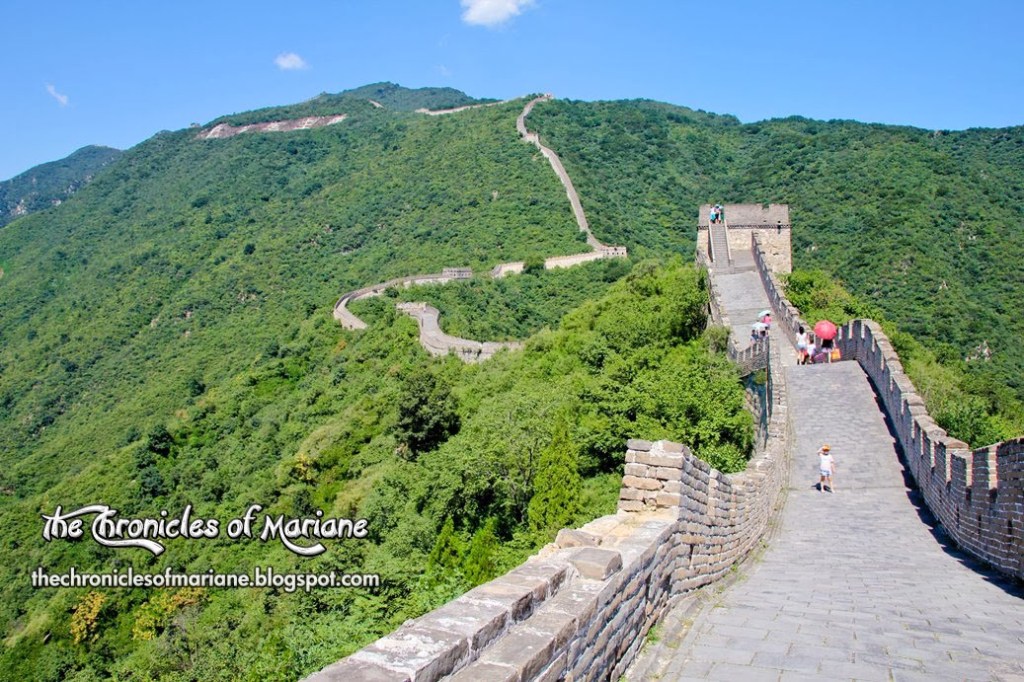
There are different sections of the Great Wall that have been made open to tourists, among the few popular are Badaling, the most accessible, also the most crowded area of the wall, while Jinshaling and Simatai features some areas that are not restored yet. Mutianyu, which I picked, was less touristy compared to Badaling and was also quite easy to reach.
Situated in Huairou County, about 70 kilometers northeast of Beijing, one would be able to locate the less touristy but nonetheless amazing Mutianyu Great Wall This section of the wall was built during the 6th century of the Northern Qi Dynasty and has served as the northern barrier protecting the capital and imperial tombs. The winding “Tail Wall” stretches for about 2,250 meters and connects with Jiankou in the west and Lianhuachi in the east. This is the best-preserved portion of The Great Wall, so you could really see and appreciate how it must have been like hundreds of years ago.
Though some might say that getting to the Great Wall of Mutianyu was quite tricky, I actually had no problems there, though it might be quite difficult coming during winter so it was probably a good thing that I picked to go during summer. From Dongzhimen station, there are different bus terminals that would take you to areas that near the Wall. As per my research, there are three buses, but two of them would still require you to rent a van and expense per person would reach 50 to 200 CNY. I took Bus 867 that only runs for two schedules and both are in the morning so I made a note to myself to wake up extra early that day. Of course, the trip going back to Dongzhimen is also organized so I had to limit my time on the wall. Nevertheless, the round trip bus fare only cost me 14 CNY, compared to taking organized tours which can run up to 300 CNY per person!
I was famished by the time we reached the entrance point. Good thing there are few eateries around the area, I actually ate at Subway! From the ticket office to the main entrance to cable car and toboggan ride, you will pass along stalls that sell cheap souvenirs. Yup, cheap because you could actually haggle for the same price that you can find within the wholesale markets in downtown Beijing.
There are different methods on how you could go up to the wall. First one is something that would require much effort, which is ascending through more than 4,000 steps. If you have a bad knee or probably just too lazy to exert effort, then you have a choice of either taking cable car trip or taking the two-rider chairlift going up then the cool toboggan going down. I came during summer and didn’t want to hike my way up since some locals told me it would take me two-hours to do (not sure until now if that is true) so I wanted to preserve my energy on the actual tour of the wall, so I bought cable car two-way tickets for 80 CNY.
he cable car ride was nothing spectacular, but that’s not what I came for. The scenery was more than I expected. I was just astounded to gaze at the 180 degree view of this massive piece of ancient Chinese architecture – from where I was sitting, it looked like this very long snake slithering its way over the peaks of the mountains.
Gorgeous views are also expected to be seen at the wall at any time of the year, the thought of going there during winter and autumn just excites me the most! Summertime is also not bad, the green colors from the trees gives the wall that soothing charm. It would have been lovely to hike my way to that winding road to the different sections of the wall.
True enough, Mutianyu really offer tourists the tranquility that you can probably not find in its touristy sections. I just couldn’t believe I am walking on something that has been made hundred of years ago, I felt like a traveled through time and have seen China’s history and how its culture evolved through the years. I have been to similar fortresses but The Great Wall is one of a kind with its power and grandeur. I took my time to take it all in and appreciate this marvel.
My daytrip to The Great Wall was such a meaningful part of my travel to China, it was not just about seeing this grand wonder but also the feeling of making it through China for twelve days alone was very rewarding and truly a proud moment for me. I guess this was one of the times where I felt that I am already taking myself to the next level as a traveler. Going to this trip for twelve days made me take risks and challenged me to rely in my own strengths and improve from my mistakes. There would have never been a perfect conclusion to my solo adventure than to see and experience The Great Wall.
 mira's blog